
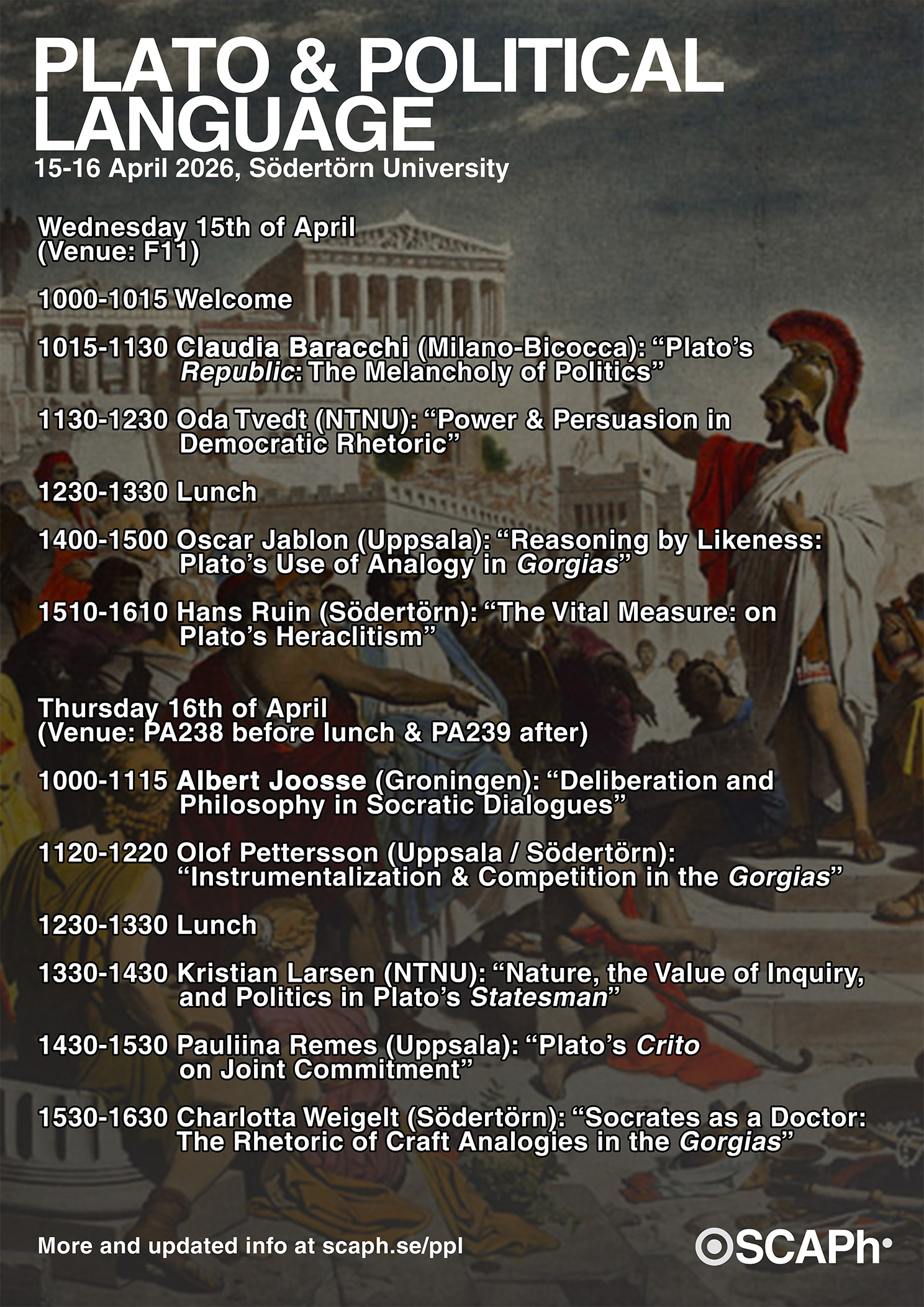
Plato & Political Language
Plato’s critical appraisal of poetry, rhetoric, and sophistry is well-documented, as is his employment of the dialogue form to challenge the social and political relevance of prominent intellectuals such as Gorgias, Prodicus, and Protagoras. However, Plato’s own discursive preference, sometimes labeled dialectic, is rarely taken to matter for his political interests. Commonly identified as the antithesis of eristic discourse or discursive competition, Plato’s political commitments to dialectic – characterized by shared deliberation, joint inquiry, and consensual ideals – are yet to be thoroughly identified and described. The purpose of this symposium is to explore this topic, discuss the difference between eristic and dialectic discourse, ask why collaborative deliberation is often favored over competitive, and to reinvigorate Plato’s relevance for questions about the nature of public deliberation.
PROGRAM
Wednesday 15th of April
(Venue: F11)
1000-1015 Welcome
1015-1130 Claudia Baracchi (Milano-Bicocca): “Plato’s Republic: The Melancholy of Politics”
1130-1230 Oda Tvedt (NTNU): “Power & Persuasion in Democratic Rhetoric”
1230-1330 Lunch
1400-1500 Oscar Jablon (Uppsala): “Reasoning by Likeness: Plato’s Use of Analogy in Gorgias”
1510-1610 Hans Ruin (Södertörn): “The Vital Measure: on Plato’s Heraclitism”
Thursday 16th of April
(Venue: PA238 before lunch & PA239 after)
1000-1115 Albert Joosse (Groningen): “Deliberation and Philosophy in Socratic Dialogues”
1120-1220 Olof Pettersson (Uppsala / Södertörn): “Instrumentalization & Competition in Plato’s Gorgias”
1230-1330 Lunch
1330-1430 Kristian Larsen (NTNU): “Nature, the Value of Inquiry, and Politics in Plato’s Statesman”
1430-1530 Pauliina Remes (Uppsala): “Plato’s Crito on Joint Commitment”
1530-1630 Charlotta Weigelt (Södertörn): “Socrates as a Doctor: The Rhetoric of Craft Analogies in the Gorgias”
CONTACT
For more information or if you have any questions, please send an email to olof.pettersson@filosofi.uu.se. The event is also posted here at PhilEvents.